 ## **Join Us: "Everything Flows" Panel Discussion with Andrea Resmini**
*Monday, 14 April 2025 | 11:00 AM - 12:30 PM Eastern*
Continue the conversation from Andrea Resmini's thought-provoking WIAD 2025 Global Keynote! Join us for a dynamic panel discussion exploring how Information Architecture is evolving beyond websites into the blended physical-digital spaces where we live and work.
Hear perspectives from diverse IA practitioners as they discuss making complex systems clear in an AI-driven world and reshaping IA practice for tomorrow's challenges. Moderated by Nate Davis, this 90-minute virtual event includes audience Q\&A.
{% embed url="
## **Join Us: "Everything Flows" Panel Discussion with Andrea Resmini**
*Monday, 14 April 2025 | 11:00 AM - 12:30 PM Eastern*
Continue the conversation from Andrea Resmini's thought-provoking WIAD 2025 Global Keynote! Join us for a dynamic panel discussion exploring how Information Architecture is evolving beyond websites into the blended physical-digital spaces where we live and work.
Hear perspectives from diverse IA practitioners as they discuss making complex systems clear in an AI-driven world and reshaping IA practice for tomorrow's challenges. Moderated by Nate Davis, this 90-minute virtual event includes audience Q\&A.
{% embed url="Weinberger, David. Everyday Chaos: Technology, Complexity, and How We’re Thriving in a New World of Possibility. Harvard Business Review Press, 2019.
Building on his earlier work in "Everything Is Miscellaneous," David Weinberger reinforces that information naturally resists clean categorization because everything is connected in multiple, complex ways. For information architects, the book encourages a shift from trying to perfectly predict and control information flows to creating resilient, adaptable systems that can thrive amid complexity and change.
| | ----------------------------------------------------------------------------------------------------------------------------------------------------------------------------------------- | ------------------------------------------------------------------------------------------------------------------------------------------------------------------------------------------------------------------------------------------------------------------------------------------------------------------------------------------------------------------------------------------------------------------------------------------------------------------------------------------------------------------------------------------------------------------------------------------------------------------------------------------------------------------------------------- | ## WIAA events ### **World IA Café conversations** In March, our regular World IA Café session is being replaced by the special "Everything Flows" Panel Discussion with Andrea Resmini (14 April) as a follow-up to the WIAD 2025 Global Keynote. Our monthly Café conversations will resume in the coming months. ### **Taxonomy Talk talks** [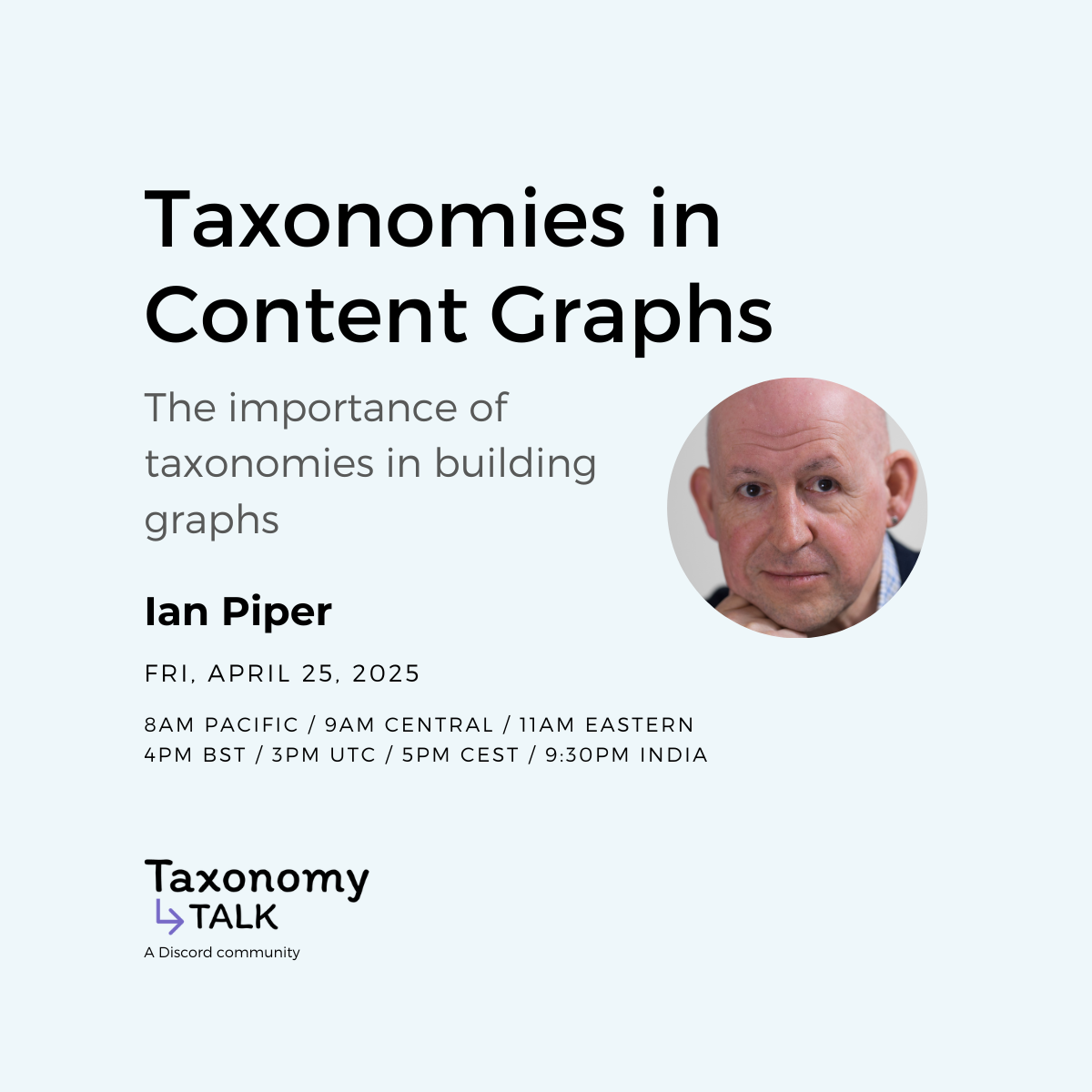](https://lu.ma/qx4tqsgy) [**Taxonomies in Content Graphs: The importance of taxonomies in building graphs** by **Ian Piper**](https://lu.ma/qx4tqsgy)\ 25 April 2025\ Piper will share how SKOS taxonomies serve as the essential "semantic glue" in content graphs, solving the challenge of disconnected content assets. Through taxonomies, information professionals can enhance content findability, relationships, and business value in graph environments. This session delivers techniques for content design, a real-world taxonomy development case study, and entity extraction methods to connect content with concepts. **We're looking for a Community Moderator!** Help shape the future of Taxonomy Talk by becoming our community moderator. This volunteer role involves facilitating discussions, coordinating speakers, and helping grow our taxonomy community. [Apply](https://forms.worldiaday.org/taxotalk-modapp) or email1
| | | ---------- | - | |2
| Stephen discusses the Scottish Government's exploration of object-oriented user experience (OOUX) to achieve better information structuring, drawing parallels with how humans learn through objects and the success of object-oriented interfaces. This human-centred approach, aligning with fundamental cognition and proven UI patterns, offers a user-centric way to organize digital content for more intuitive and effective systems. Applying object-oriented UX principles to information architecture can lead to better information structuring. | | ---------- | ----------------------------------------------------------------------------------------------------------------------------------------------------------------------------------------------------------------------------------------------------------------------------------------------------------------------------------------------------------------------------------------------------------------------------------------------------------------------------------------------------------------------------------------------------------- | |3
| | | ---------- | - | |4
| | | ---------- | - | *** ## From our Community Partners | [](https://www.optimalworkshop.com/) | The Information Architecture Conference will be in Philadelphia! Connect with IA leaders, practitioners, and thinkers for workshops, talks, karaoke and polar bear walks. Registration is now open—Workshop and registration is open until April 29. Register with "FRIEND50" for USD 50 off. | | ---------------------------------------------------------------------------------------------------------------------------------------------------------------------------------- | --------------------------------------------------------------------------------------------------------------------------------------------------------------------------------------------------------------------------------------------------------------------------------------------- | | [](https://rosenfeldmedia.com/) | As 2025 continues, it’s clear that artificial intelligence (AI) has become more than just another buzzword. It’s reshaping the landscape of user experience (UX) design. In fact, there are many exciting opportunities arising in the UX field because of advancements made with AI. But how do we navigate this shift toward an AI-oriented future while also being mindful of its shortcomings? | | -------------------------------------------------------------------------------------------------------------------------------------------------------------------------- | -------------------------------------------------------------------------------------------------------------------------------------------------------------------------------------------------------------------------------------------------------------------------------------------------------------------------------------------------------------------------------------------------- | |