> For the complete documentation index, see [llms.txt](https://www.information-architecture.world/llms.txt). Markdown versions of documentation pages are available by appending `.md` to page URLs; this page is available as [Markdown](https://www.information-architecture.world/state-of-ia/reports/2020-wiad-attendee-survey-analysis.md).
# 2020 WIAD Attendee Survey Analysis
2020 World Information Architecture Day Attendee Survey Analysis presented by World IA Day and Optimal Workshop
## Background
As part of an ongoing relationship with the nonprofit organization World IA Day (WIAD), Optimal Workshop (OW) has been asked to contribute to a research project investigating the prevalence of information architecture (IA) skills across various industries and careers. The study was designed and conducted by the WIAD team and the study's results were given to OW for analysis.
### How we conducted the study
We recruited participants from attendees of local WIAD events around the world and asked them to complete a card-sorting task using OptimalSort. Cards contained descriptions of common IA tasks and we asked participants to organise the cards into groups based on how often they carried out the task. We gathered demographic information via questionnaires before and after the card-sorting activity. Participants completed the study in either English (87%) or Spanish (13%).
**We had two broad research questions:**
1. What kinds of people attended the local WIAD events?
2. How prevalent are IA skills in the workplace across different careers/industries?
## Preliminary findings
### Question 1: Who attended the local WIAD events?
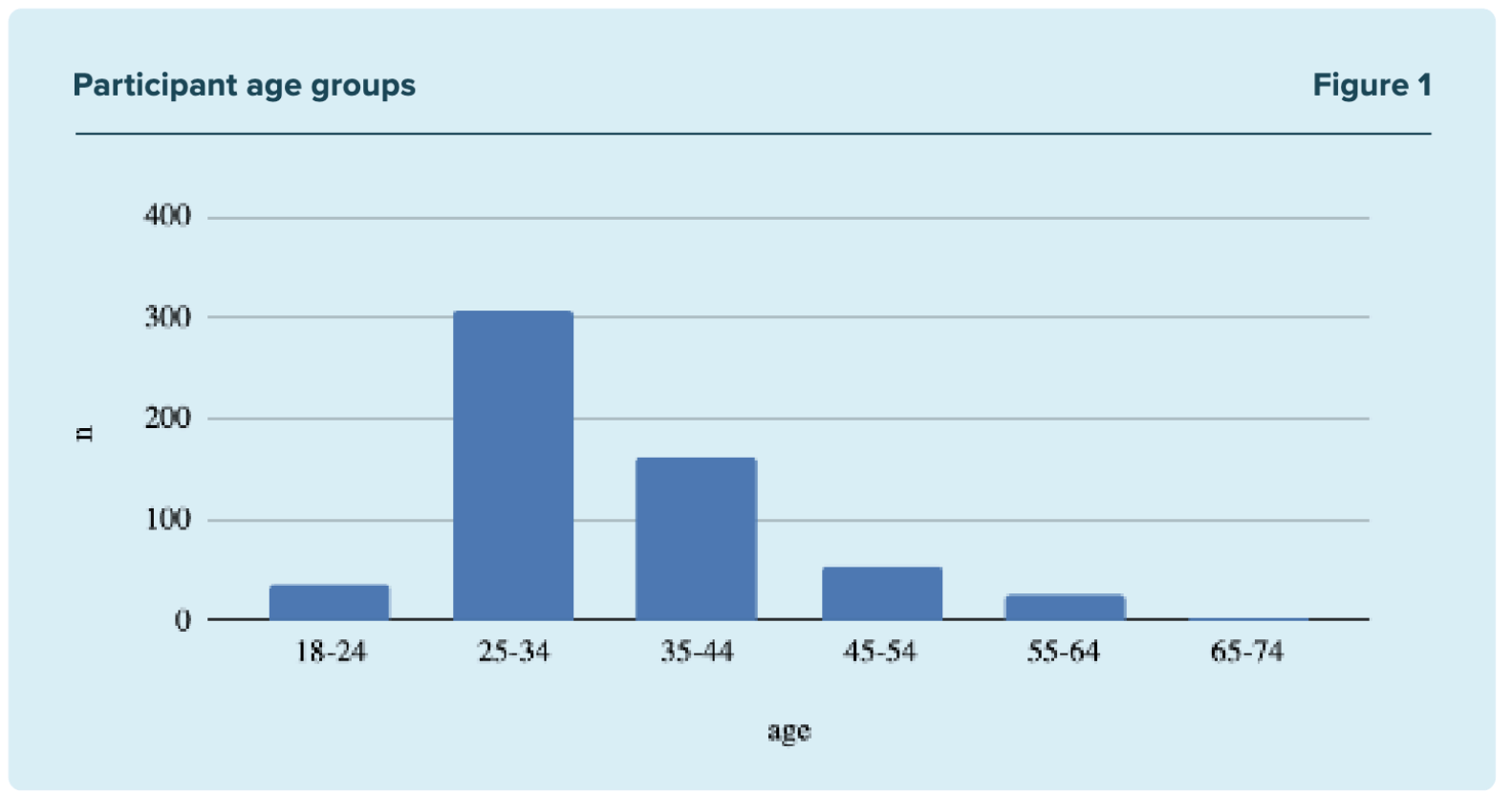
A large proportion of attendees responded that they were early in their career with over half of all respondents (53%) having less than 6 years experience in their field. Additionally, the age range of participants skewed towards younger individuals. This may reflect an intention to upskill or network with other professionals in the industry.
Figure 1. Participant age groups
Figure 2. Career experience
Unsurprisingly, an overwhelming majority of participants identified themselves as working in a 'UX design' role of some kind. A small proportion of participants identified themselves as 'Information Architecture' specialists while the remainder of the sample were spread across a range of roles with most fitting into the broader umbrella of e-commerce.
These findings highlight the fact that attendees of the local WIAD events represent a fairly niche sample of the wider workforce.
Figure 3. Roles of WIAD attendees
### Question 2: How prevalent are IA skills across the workforce?
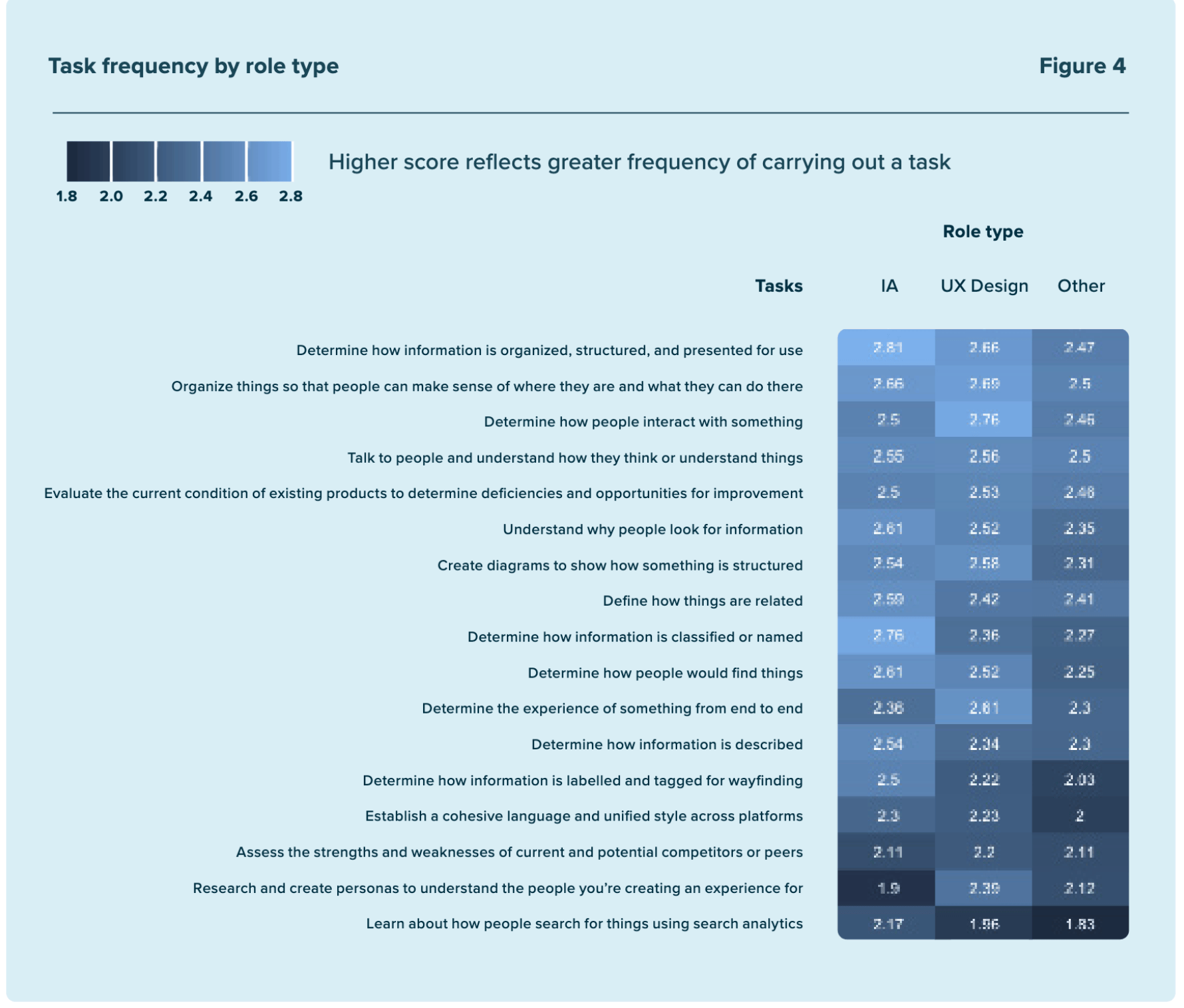
Since an overwhelming majority of participants reported working in a UX Design role, all other participants were categorized as either 'IA specialists' or 'Other' so that broad differences might be found between career types. Scores ranging from 1-3 for each of the lA tasks were generated based on the category that task was sorted into with Higher scores reflecting a greater likelihood of that task being part of their typical work day.
Nearly all tasks had an average score greater than 2 which supports the idea that, on average, these lA skills are used at least occasionally by all types of working roles. In general however, tasks had higher average scores for 'IA specialists' and 'UX Designers' than for 'Other' role types. This likely reflects the idea that tasks in this survey represent core responsibilities of people in UX designer roles compared to being incidental activities in other careers.
Figure 4. Task frequency by role type
The three tasks at the bottom of figure 4 (see perevious page) had significantly lower scores among ''A specialists' and were described as being carried out only 'Occasionally'. It's therefore possible that these skills do not represent fundamental lA skills in the first place.
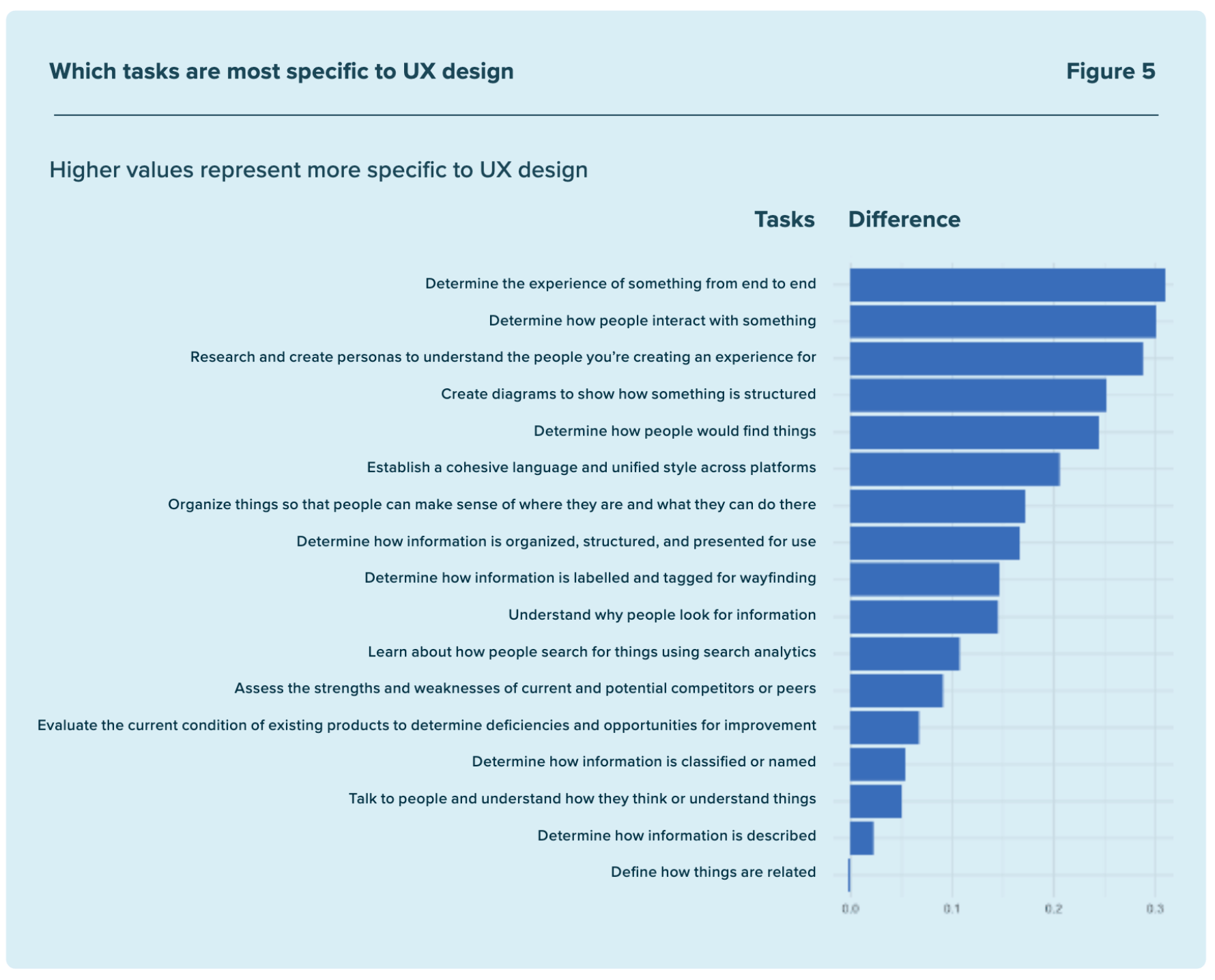
To investigate this idea further, we saw tasks ranked according to the difference in average scores between UX design/lA roles and 'Other' role types. Higher scores on this measure indicate that a task is more likely to be part of an UX Design/lA role than other roles in the workforce.
The most specific UX task was "Determine the experience of something from end to end" while the least specific task was "Determine how things are related" which showed almost no difference between job types.
Figure 5. Which tasks are most specific to UX design
## Limitations and future research
There were three major limitations to the data we collected using the method described briefly above. Firstly, we collected the key variables of 'Job Title' and 'Industry' via free text inputs, meaning there were nearly as many unique values as there were participants in the survey. Some guess-work was required to consolidate the various responses into meaningful categories.
Secondly, we asked participants to group various IA tasks according to whether they performed the task 'Regularly', 'Occasionally', or 'Never'. Aside from each option being somewhat ambiguous (is once a week regular or occasional?), having so few options left little room for participants to differentiate themselves from each other. In other words, since a large proportion of responses fit in the 'Regularly' category most participants look very similar.
To improve future studies it would likely be more efficient to use a standard survey tool such as OW Questions instead of a card-sorting task. This survey should avoid free-text inputs where possible and could also benefit from a wider range of responses with more descriptive labels such as 'Once per week' instead of 'Sometimes'.
Additionally, if the broader research goal is to understand how important/widespread IA skills are in the general workforce, it will be important to gather participants from outside the list of local WIAD event attendees since this sample is heavily skewed towards people in UX design/lA careers.
## Download report
{% file src="/files/juxAmqYhpS39Ugxq4Sig" %}
{% file src="/files/TYuvMgf9Lpzymt7pMEaT" %}
## Survey questions
Job Skills Final [Google Sheets](https://docs.google.com/spreadsheets/d/18kQms-AuegBMLaVvBsqD3_HncQvKtSoVq55zhZtRfpM/edit?usp=sharing)
Survey was available in English, Spanish
### Contributors
* Grace Lau, Lead
* Paolo Montevecchi, Editor
* Krispian Emert, Editor
* Nicole So, Editor
* Wilson Sánchez, Translation, Spanish
* Elaine Chu, Proofreader
* Amy Wilcox, Proofreader
* Andrew Jung, Proofreader